
Professional Certificate in Missing Persons Investigation and Search
MP-Tracker™ Method. Learn to tell what kind of disappearance you are investigating before you decide where and how to search.
A 150-hour online program for investigators, forensic and legal professionals, police and rescue personnel, NGOs and families. It covers recent disappearances as well as archived and unsolved cases, in any country.
Enrollment is open year-round. Questions first? Write to info@idef.institute.
- Format
- Online and self-paced
- Length
- 150 hoursUsually 3 to 6 months
- Tuition
- $540Or 3 payments of $180
- Certificate
- Issued by IDEF LLC (USA)Can be apostilled
- Language
- English course materialsVideo lessons in Spanish with English subtitles
What you will learn
The program trains you to investigate missing-person reports with a documented method. You will learn to:
- Classify the manner of disappearance with the NASH-E/S model and justify which hypothesis must be investigated first.
- Apply MP-Tracker™, the method and platform developed by IDEF's research and development department, so that every hypothesis and every search decision rests on the case evidence rather than on intuition.
- Plan the field search and coordinate with relatives, public agencies, police and legal advisers, within the legal framework of your country.
By the end of the program you will be able to:
- Build victimological and suspect profiles, integrating risk factors and data triangulation.
- Plan field searches from the missing person's mental map, the geography of the area and the time elapsed.
- Coordinate interdisciplinary teams and handle sensitive information with ethical and criminological judgment.
- Write expert reports with graded conclusions and stated limitations, prepared for cross-examination.
- Offer your services as a consultant or expert: fees, contracts and institutional partnerships.
Not every disappearance is the same
A natural or medical cause, an accident, suicidal behavior, voluntary evasion and third-party involvement each call for different evidence, priorities and lines of investigation. Treating them all the same way scatters resources and delays critical decisions. The NASH-E/S classification sets the order of the investigation before resources move into the field.
- NNatural
- A natural or medical cause.
- AAccident
- An accidental event.
- SSuicide
- Suicidal behavior. The presence or absence of a pre-suicidal state is assessed.
- HThird-party involvement
- Abduction, kidnapping, homicide or enforced disappearance.
- E/SEvasion or simulation
- A voluntary absence, or a disappearance staged by the person.
The method covers the whole life of a case: recent or active disappearances, ongoing investigations, retrospective (ex post facto) analysis, and archived or unsolved cases. How the MP-Tracker™ method works
Methodological note. The classification is a working hypothesis subject to review by a competent professional. It is not an accusation or a proven fact, it does not replace or delay the report to the authorities, and its legal effects depend on the law of each jurisdiction.
Who the program is for
Forensic experts, forensic psychologists, lawyers and investigators
An expert report falls apart when the manner of disappearance has not been justified. You will learn to classify the missing-person report with the NASH-E/S model, base each hypothesis on the case evidence rather than on intuition, and reopen the analysis of archived cases with a method others can check.
A specialization few professionals can show, backed by a certificate that can be apostilled.
Police officers, search and rescue, firefighters and public officials
Every deployment made without a prior classification costs hours, staff and budget. You will learn to classify the report before moving resources, read early leads, narrow down search areas and prioritize lines of search with MP-Tracker™.
More effective searches with the resources you have. It complements your agency's protocols; it does not replace them.
Families, volunteer search groups and NGOs
Instead of waiting for answers, you will learn to build them: organize the information in your case, recognize which scenario the evidence points to, and draft specific requests for investigative steps to prosecutors and police.
The same method taught to forensic experts and police officers, applied to your own case.
IDEF has trained relatives of missing persons, rescuers, firefighters, investigators, members of NGOs and police officers from Honduras, Guatemala, Mexico and Spain.
The method, applied to a case
This is the route you follow in the capstone project, and the same one MP-Tracker™ follows when a trained investigator operates it.
Simulated case. Teaching example with fictitious data.
Case facts
A 27-year-old woman was last seen leaving work on a Friday at 7:40 p.m. She did not arrive home, 3.2 km (2 miles) away. Her phone has shown no activity since 9:10 p.m. No known medical or psychiatric history. She withdrew cash that afternoon and left her personal documents at home.
NASH-E/S classification
Natural and suicide are set aside for now, for lack of indicators. Three manners remain in competition: accident, evasion and third-party involvement. The cash withdrawal supports evasion; the documents left at home weaken it.
Primary hypothesis
Third-party involvement on the route between work and home, within the 7:40 to 9:10 p.m. window. Evasion remains a live alternative hypothesis: it is not ruled out, it is ranked second.
Search plan
The 2-mile corridor is narrowed down and the cameras along the route are checked for that time window. The points of interest in her routine are visited and the immediate surroundings are checked, without suspending the area search.
Report
Each decision is written down with its basis and its time. The manner is stated as a hypothesis open to review, not as a proven fact, so that the document can withstand review in court.
Curriculum: four modules, 150 hours
75 hours of theory and 75 of practice, built on teaching case files and practice cases in MP-Tracker™. Open each module to see its content.
1Establishing a disappearance30 hours
Definition of a missing person and of presumed misfortune (presunta desgracia). Disappearance cases at local and international level. Victimization index and incident risk in missing-person reports. Manners of disappearance vs. manners of death in the search for missing persons. Behavior prior to a disappearance (retrospective view) and the missing person's routine. Time and space variables after a person goes missing. The family of a missing person. Psychological and behavioral profiles of missing persons.
2Strategy for the investigation and search for missing persons30 hours
First steps in the search, and strategic search management by close relatives. The missing person's mental map; geography and topography of the search. The work of police officers, lawyers, the press and psychologists in the search for missing persons. Psychological intervention and therapy for relatives of missing persons. The investigative hypothesis and destination motivation. Third-party involvement (enforced disappearance, kidnapping, homicide) and voluntary evasion: the profile of an evader. Etiology of a disappearance; unsolved cases and ex post facto disappearances. Introduction to the MP-Tracker™ protocol in the search for and management of missing persons.
3Forensic expert assessment in cases of lost or missing persons45 hours
The material of the expert assessment: lead, evidence and proof; chain of custody, lawfulness, relevance and sufficiency of evidence. The sources: institutional sources of reliable information, triangulation and traceability of data. The expert instruments: criminalistic methodology, criminal and geographic profiling, and psychological autopsy. Manners of death (N.A.S.H.) and manners of disappearance (N.A.S.H.-E): the congruence criterion. The MP-Tracker™ Protocol as a forensic expert assessment, including in long-standing, archived or unsolved cases. Writing the expert report: graded conclusions, limitations and anticipating cross-examination.
4Practical application of the MP-Tracker methodology and career paths45 hours
The MP-Tracker workflow, from the report and follow-up to the closing of the case, operating the platform in Investigator mode. Guided application from scratch, on your own practice cases with fictitious data. Adapting the protocol and the reports to babies, children, adolescents, adults and older adults; archived or unsolved cases. Veracity check: tabulating lies or attempts to deceive MP-Tracker. Writing and defending expert reports for court proceedings. Capstone project: solving, with the MP-Tracker™ methodology, a simulated case whose outcome only your tutor knows. Career paths: where graduates work, consultancy, fees and contracts, institutional partnerships and business models for expert services, and how archived cases can be brought back to court.
After the program. Graduates can apply for the MP-Tracker Expert Certification, to practice the method with a registration number and cases assigned by IDEF; the certificate program tuition is credited toward its price. Ask us for details.
How you study
- Online classroom
- Open 24/7, in English: video lessons (recorded in Spanish, with English subtitles), readings, protocols, module exams and assignments. You start with an entry test, which is required but not graded.
- Hands-on practice
- Practice cases with fictitious data in MP-Tracker™ (Investigator mode), teaching case files and a capstone project: you solve a case whose outcome only your tutor knows, and you defend your analysis in writing, in English, answering your tutor's questions.
- Grading
- Each assignment states how it is graded. The passing score is 70%, with up to two attempts.
- Mentoring
- You send written questions from the online classroom. The author of the method or an adjunct lecturer answers in English, in writing or in a personalized video with English translation.
- Materials
- Protocol manuals and report tables by age group, included.
- Length
- 150 academic hours, usually over 3 to 6 months. Up to 12 months for documented work, medical or family reasons. There are no fixed start dates.
Evidence behind the method
MP-Tracker™ is an original method developed by IDEF to classify missing-person reports and guide the investigation before the field search. Chile's Public Prosecutor's Office includes its classification in an official protocol and names the source:
“Adaptado de MP – Tracker (Rastreador de personas desaparecidas). IDEF. Instituto Delitológico de Ciencias Forenses y Periciales”
“Adapted from MP-Tracker (Missing Persons Tracker). IDEF. Instituto Delitológico de Ciencias Forenses y Periciales.” (Our translation.)
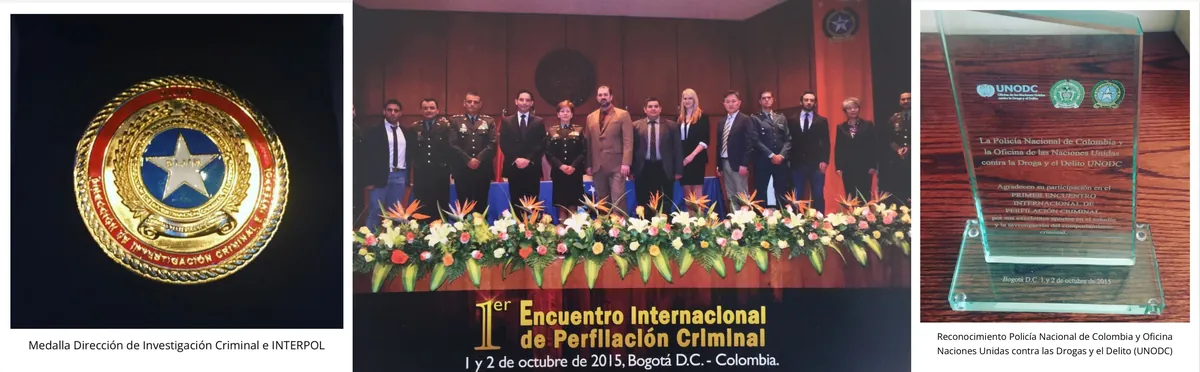
- 2015Presented at the First International Meeting on Criminal Profiling in Bogotá, Colombia, before the Colombian National Police and the United Nations Office on Drugs and Crime (UNODC).
- 2017Presented at the University of Guadalajara, Mexico. Press coverage by Milenio (in Spanish)
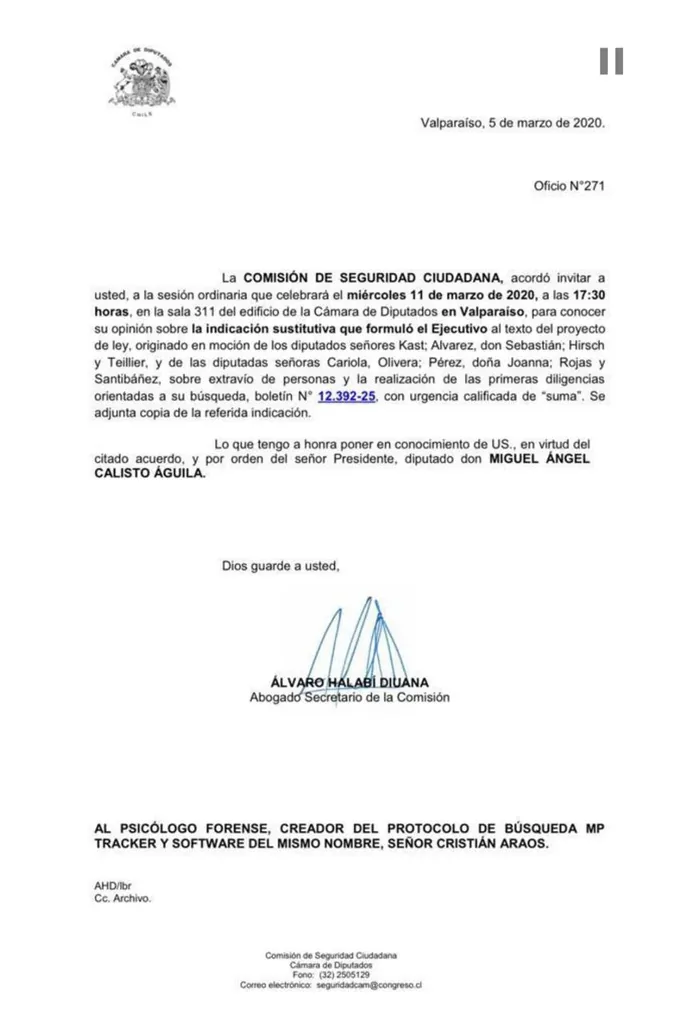
- 2020Chile's Chamber of Deputies, Citizen Security Committee: Official Letter No. 271 invited the method's author to give his opinion during the passage of the bill on missing persons (Bulletin No. 12,392-25) that became Law 21,500. Committee document (in Spanish)
Lead instructor
Cristián Alejandro Araos Díaz, psychologist. Author of the MP-Tracker™ protocol and platform.
Legal and forensic psychologist, criminal profiler and behavioral analyst, and director of the Instituto Delitológico de Ciencias Forenses y Periciales (IDEF LLC). He teaches forensic psychologists, criminologists, forensic experts, prosecutors and judges, and has worked as a forensic expert in human rights cases and on expert reports for oral trials. He is approved as a court expert by Chilean Courts of Appeal for 2026–2027.
At the First International Meeting on Criminal Profiling (Bogotá, October 1–2, 2015) he received a Medal of Honor from DIJIN, the Directorate of Criminal Investigation and INTERPOL of the Colombian National Police, together with recognition from the Colombian National Police and UNODC. He has lectured in Mexico, Peru, Bolivia, Colombia, Panama, Argentina and Spain.
Areas of practice
- Legal and forensic psychology: forensic psychological assessment, criminal responsibility.
- Behavioral and criminal analysis: criminological profiling, criminal psychopathy, psychological autopsy.
- Intervention and prevention: suicidology, clinical neuropsychology.
Certificate and admission requirements
Certificate awarded
Professional Certificate in Missing Persons Investigation and Search (MP-Tracker™ Method), issued by IDEF LLC (EIN 32-0701556), with a specialization in the MP-Tracker™ methodology and manners of disappearance, once you have passed the program and all tuition is paid.
It can be apostilled under the Hague Apostille Convention for use in its more than 120 contracting parties, subject to the professional or administrative requirements of each jurisdiction. The apostille authenticates the signature on the certificate; it does not by itself grant official recognition. This is a professional, non-degree certificate.
Admission requirements
Check that you meet them before paying. If you are unsure, email us and we will review your case with no obligation.
- A professional or technical qualification in a related field, or being a relative of a missing person, or demonstrable experience in the field.
- A copy of an identity document.
Institutional background
IDEF has trained forensic specialists since 2008 and is a legal entity in the United States and in Chile. The academic team linked to the institute includes experts approved by Chilean Courts of Appeal for 2026–2027.
Tuition and enrollment
Enrollment is open year-round and there are no fixed start dates: you begin as soon as your access is ready and progress at your own pace, with a tutor assigned to you. All prices are in US dollars.
$540total tuition
Or 3 payments of $180 by card, usually one a month.
Payments are processed by Stripe and PayPal, with an automatic receipt; IDEF never sees your card details. With installments, you pay each one with the same link: the first opens Modules 1 and 2, the second Module 3 and the third Module 4, and the certificate is issued once all three are paid. By paying you accept the enrollment terms.
Included
- 150 hours of specialized training
- MP-Tracker™ protocol manuals and report tables by age group
- Personal mentoring in English from the author of the method or an adjunct lecturer
- Certificate issued by IDEF LLC, which can be apostilled
- No enrollment fee or other charges
Direct payment: $486
10% off when you pay by bank transfer or Western Union. Email us for the payment details.
After you pay
Payment
You receive an automatic receipt by email.
Your documents
Email a copy of your ID and your qualification, transcript or proof of experience (or of being the relative of a missing person) to info@idef.institute. Include your full name, country, phone number and receipt number.
Subject: Enrollment documents, Missing Persons Certificate (English)
Access
Your access to the online classroom is set up within one business day, and you receive a welcome email in English with your access details.
Frequently asked questions
Do I need previous experience in investigation?
No. MP-Tracker™ was designed to make investigation accessible. The program takes you from the fundamentals to advanced techniques, for experienced professionals and for people without investigative experience, including relatives of missing persons who want to take part in investigations with scientific rigor.
What language is the course taught in?
The online classroom, readings, protocols, assignments and exams are in English. The video lessons were recorded in Spanish and have English subtitles. The MP-Tracker platform's screens are in Spanish; the course includes an English quick guide to them.
Mentoring is in English: you send your questions in writing and receive personalized answers in English, written or in a video with English translation. There are no live sessions in English.
How long does the program take?
150 academic hours, usually over 3 to 6 months at your own pace. Exceptionally, up to 12 months for documented work, medical or family reasons.
Can I pay in installments?
Yes: three payments of $180 by card, usually one a month. Each payment opens the next part of the course, and the certificate is issued once all three are paid. You can also pay $540 in a single payment by card or PayPal, or $486 by bank transfer or Western Union (email us for the details).
Is the certificate recognized internationally?
It is issued by IDEF LLC (EIN 32-0701556) and can be apostilled under the Hague Apostille Convention for use in its more than 120 contracting parties, subject to the professional or administrative requirements of each jurisdiction. The apostille authenticates the signature on the certificate; it does not by itself grant official recognition. This is a professional, non-degree certificate. If you are unsure about recognition in your country, ask us before enrolling.
Will it make me a court-appointed expert or a licensed investigator?
No. The certificate documents your training in the method. Expert appointments and expert-witness work depend on the rules of each jurisdiction, and in the United States private investigator licensing is regulated by the states; this certificate is not a license. Module 4 covers career paths and expert work.
What support will I receive?
Access to the online classroom 24/7, support by email and WhatsApp every day of the year, and personal mentoring throughout your studies: you send your questions in writing, and the author of the method, Cristián Araos Díaz, or an adjunct lecturer answers them in English, in writing or in a personalized video with English translation.
Is the program also available in Spanish?
Yes. IDEF teaches the same program, with the same content and tuition, entirely in Spanish. Email us if you would like the details.
Can IDEF help with an active missing-person case?
If someone is missing right now, contact your local police or emergency number immediately (911 in the United States). This program is professional training; it is not an emergency or search service.
Start when you are ready
$540, or 3 payments of $180. Access within one business day.